Research

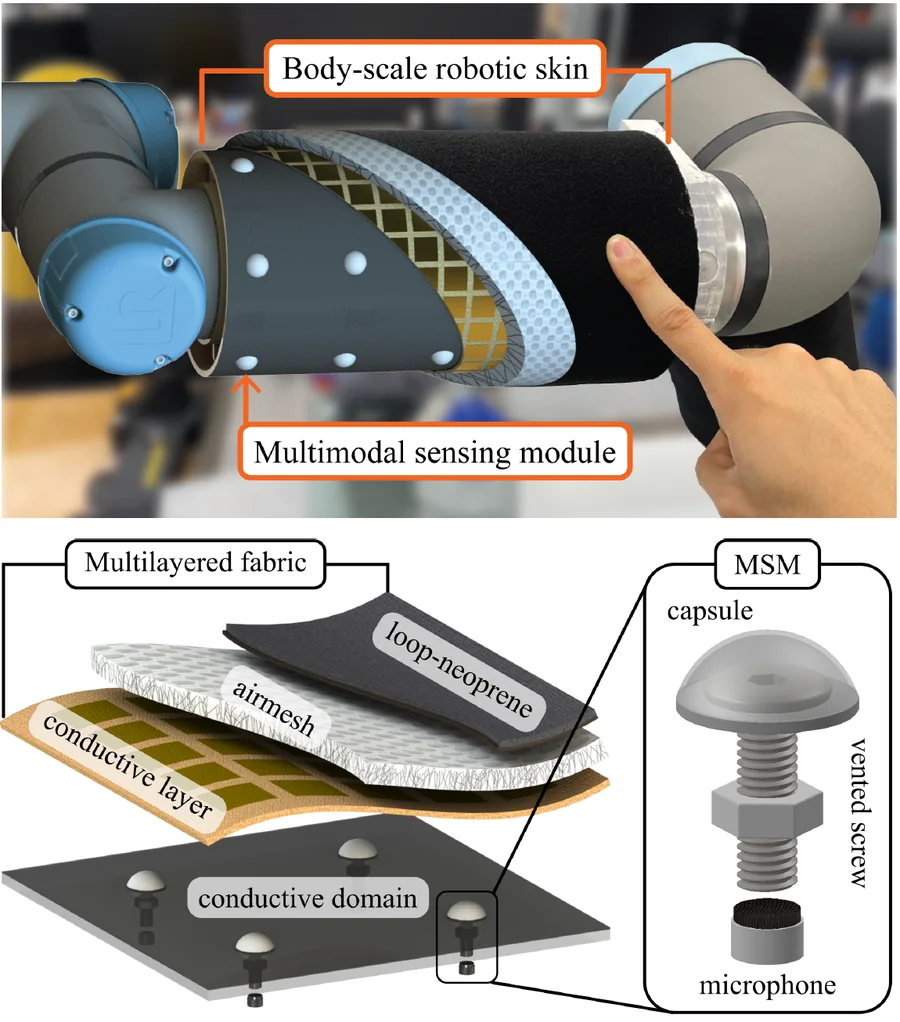
Body-scale robotic skin on a robot arm, with an exploded view of the multilayered fabric and the multimodal sensing module (capsule, vented screw, microphone)

Fabric-based robotic skin using multimodal sensing modules

Jul. 2022 – Jan. 2024

  • A robotic skin designed with multimodal sensing modules (MSMs) and multilayered fabric to have two complementary transducing mechanisms.
  • The complementary sensibilities improve classifying 10 touch types.
  • The MSM integrates two types of transducer and can be easily made on rigid surfaces with its vented screw, simplifying a fabrication.
  • The multilayered fabric is light and flexible to easily conform on three-dimensional surfaces.
  • The skin fabricated on a robotic arm to demonstrate physical human-robot interaction by reacting differently to various touches.
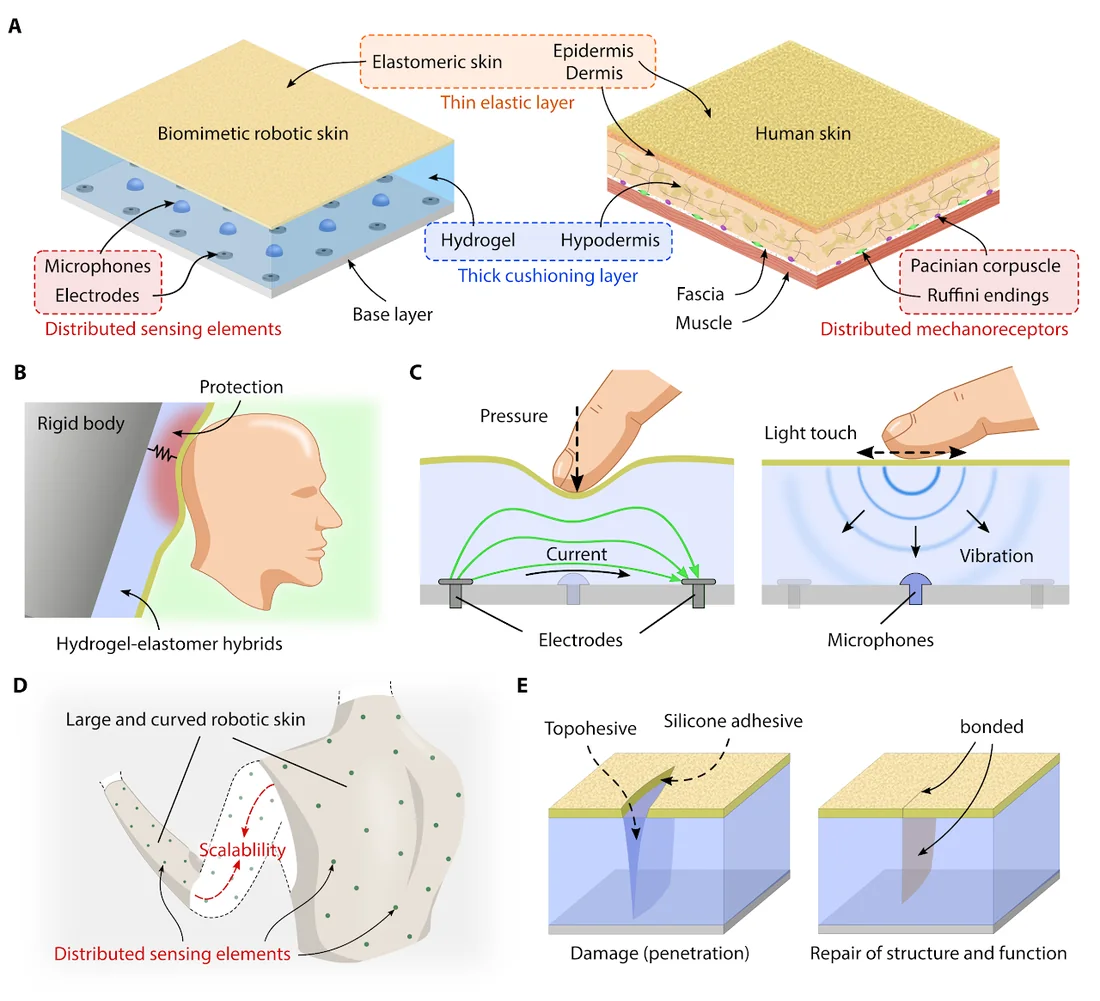
Biomimetic robotic skin compared with human skin layers, its pressure and vibration sensing principle, large curved skin, and repair after damage

Repairable biomimetic elastomeric robotic skin

Mar. 2021 – Jun. 2022

  • A skin-inspired multi-layer structure is fabricated with silicone elastomer and ionic hydrogel to transmit alternating electric currents and vibrations in response to touch.
  • Tomographic imaging methods are utilised to reconstruct a multi-modal tactile image from measurement data.
  • The skin can be repaired even after severe damage, such as an incision, using chitosan topohesive and silicone adhesive.
  • A sensorised prosthesis is made as a proof-of-concept.
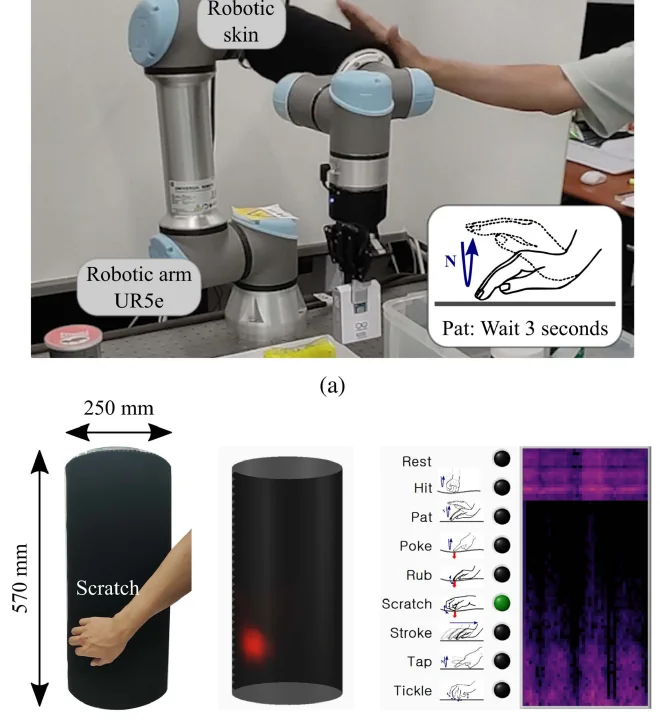
Robotic skin with embedded microphones on a UR5e robot arm reacting to a pat, and a large cylindrical skin localising and classifying a scratch

Robotic skin using microphones for dynamic touch perception and touch classification

Jan. 2019 – Nov. 2022

  • Microphones are sparsely distributed beneath a textured fabric to collect vibrations elicited by a dynamic touch.
  • Collected vibrations are processed with an analytical decay model to localise a touch and achieve a super-resolution.
  • Spatiotemporal properties of signals are analysed with CNN to classify touch types (pat, rub, etc.).
  • The skin is made on a large cylindrical surface and robotic arm to demonstrate scalability and physical human-robot interaction application.
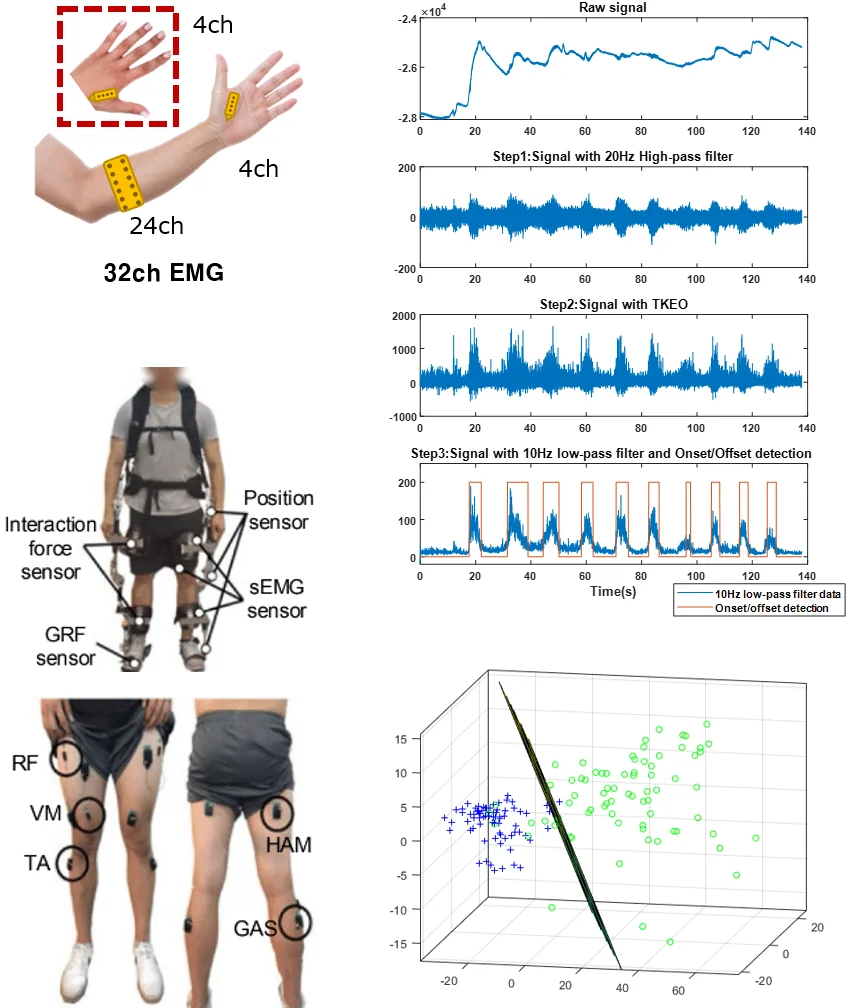
32-channel EMG electrodes on the hand and forearm, sEMG sensors on a lower-limb exoskeleton, signal-processing steps, and a classification plot

Intention and environment recognition using surface electromyography (sEMG)

Mar. 2018 – Dec. 2021

  • sEMG is used for various recognition tasks in human-machine interfaces by its early detection compared to physical sensors.
  • Different forms of sEMG and signal processing methods are implemented depending on the subject and target application.
  • For assistance in a healthy subject, single-channel electrodes are attached to multiple muscles to recognise gait environment and motion intention.
  • For hand motion rehabilitation in stroke patients, high-density electrodes are used to detect an intention in binary classes from poor signal quality.